Own your data with Self hosting today!
Have you ever looked at your digital life and realized you don’t actually own any of it?
A few months ago, I hit a breaking point. Between forced Windows updates that broke my workflow and the creeping realization that my personal data was being farmed by every “free” service I used, I decided to jump ship. I moved to Linux, and as I wrote in my previous post, I’m never looking back.
But moving to Linux was only phase one. Phase two was harder: How do I replace the “Magic” of the cloud without giving my soul to Big Tech?
To solve this, I built a tool (and a philosophy) I call Self-Hosting Magic. Here is why I did it, how it works, and why you should consider making the switch too.
In this article
The “Cloud” is Just Someone Else’s Computer
We’ve been conditioned to believe that “The Cloud” is a magical, ethereal place. In reality, it’s a server in a warehouse owned by a corporation that views your privacy as a secondary concern to their quarterly earnings.
When I transitioned to Linux, I didn’t just want a new OS; I wanted a new way of interacting with technology. I wanted:
- Privacy: No telemetry, no tracking.
- Persistence: My tools shouldn’t change or disappear because a CEO decided to “pivot.”
- Performance: Running services locally or on dedicated hardware is almost always faster than pinging a server halfway across the world.
Introducing: Self-Hosting Magic
My “Self-Hosting Magic” repository is the culmination of months of testing, breaking things, and finally finding the “Sweet Spot” of open-source alternatives. It isn’t just a list of apps; it’s a blueprint for a self-sovereign digital life.
The Core Pillars of the Magic Stack
If you’re looking to transition, these are the heavy hitters that changed everything for me:
1. The Home Lab Foundation (Docker & Portainer)
The “Magic” starts with Docker. Instead of installing software directly onto your OS and cluttering your system, everything runs in isolated containers. I use Portainer to manage them. It gives you a beautiful web interface to see exactly what’s running, how much RAM it’s using, and allows you to update everything with a single click.
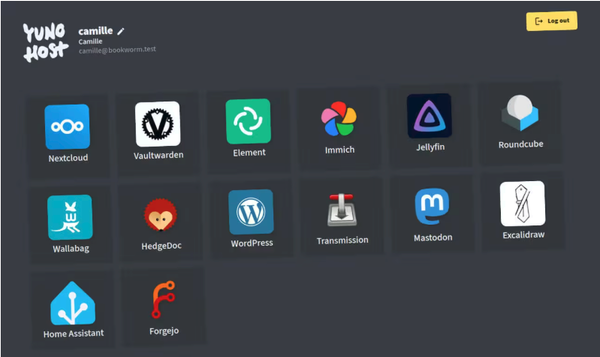
2. Reclaiming Your Data (Nextcloud)
If Google Drive and Dropbox had a more secure, more capable cousin, it would be Nextcloud. It handles my files, contacts, and calendars. The best part? The “Instant Upload” feature on my phone works exactly like Google Photos, but the photos land on my hard drive, not a server in Mountain View.
3. Professional Grade Communication (Matrix/Element)
Discord is great until they decide to change their UI or sell your data. I’ve transitioned my core communications to Matrix. It’s decentralized, end-to-end encrypted, and—most importantly—I bridge it to other services so I can stay in one app.
4. Media Sovereignty (Jellyfin)
Subscription fatigue is real. Netflix, Disney+, Hulu—it never ends. Jellyfin is the open-source answer to media streaming. I own my media. No “content licensing” issues, no disappearing shows, and no monthly fees.
The “Hard” Part (That isn’t actually that hard)
The biggest barrier to self-hosting is the fear of the command line. People think you need a PhD in Computer Science to run a server.
You don’t.
That’s why I created the Open-source-transition guide. I wanted to lower the barrier to entry. If you can copy and paste a few lines into a terminal, you can have a private cloud running in twenty minutes.
Why This Matters
Every time we choose an open-source tool over a proprietary one, we are voting for a different kind of internet. An internet where the user is the owner, not the product.
My journey from Windows to Linux was the spark, but self-hosting is the fire. It’s about taking responsibility for your digital footprint. It’s about the peace of mind that comes with knowing that if a major tech company goes bankrupt tomorrow, your digital life remains intact.
Get Started Today
If you’re tired of the “subscription-everything” model and the feeling that your computer isn’t really yours, I invite you to check out the repo:
👉 Open Source Transition & Self-Hosting Magic
It’s time to take your data back. It’s time for a little bit of magic.